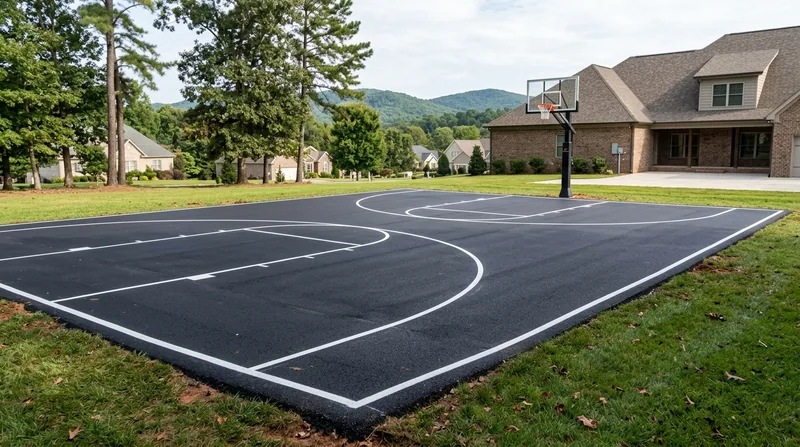




Backyard basketball courts, tennis courts, and walking paths in Hickory face a unique challenge: the Piedmont clay beneath them shifts and heaves with every wet and dry cycle, and ordinary driveway bases fail under the concentrated load and foot traffic of a court. We grade and compact a deep aggregate base, then pave with hot mix asphalt so the court stays flat and playable through Hickory's 45 inches of annual rainfall and the clay movement that breaks apart single-car drives. A properly built court in Hickory, Conover, Newton, or Maiden will hold for 15 to 20 years with routine maintenance, because the foundation is built to resist what the ground underneath actually does.
Why Sports Court & Path Paving Matters in Hickory's Clay Country
The reddish Piedmont clay that supports Hickory's mill-village neighborhoods and the mid-century ranch belt around it is heavier and slower-draining than coastal sand, and it shrinks and swells through wet spells and dry months. A driveway tolerates some movement, but a basketball court or tennis court demands a flat, stable surface. When the base is shallow or improperly compacted, the clay underneath flexes and the asphalt cracks, settles unevenly, or develops birdbaths (low spots that collect water). Backyard paths that cut through yards with poor drainage fail even faster because water stands on them and works its way down into an unconfined base.
- We excavate and grade the subgrade to remove organic material and establish proper slope for drainage.
- We place and compact a deep aggregate base (typically 6 to 8 inches for courts, 4 to 6 inches for paths) in lifts to resist clay heave and distribute loads evenly.
- We proof-roll the base to verify compaction before asphalt is laid, so settlement does not occur after paving.
- We pave with hot mix asphalt at the proper thickness for the intended use (courts need 2.5 to 3 inches; paths can be 2 to 2.5 inches).
A court built this way stays flat and playable because the base beneath it is strong enough to resist the clay movement that destroys shallow or poorly compacted foundations.
Key info: Hickory's rolling terrain and Catawba River drainage basin mean runoff crosses courts and paths hard after heavy rain. Proper grading and a compacted base are not optional extras; they are the difference between a court that lasts and one that fails within five years.
For detailed guidance on how clay and base preparation affect any asphalt project, see our page on gravel driveway installation and grading, where the same principles apply.
How We Build a Court or Path in Hickory: The Process
A sports court or path job begins on site. We measure the area, assess the existing grade and drainage, probe the soil to understand what we are working with, and identify any utilities that must be marked before we dig. North Carolina law requires a utility locate (call 811 before any excavation), and we handle that as part of the job. Once we know the site, we quote tonnage and thickness so you have a written estimate that specifies what goes in the ground and what goes on top.
- We call 811 and wait for utility marks before any excavation begins.
- We excavate to the depth needed for base material, removing soft or organic soil down to stable subgrade.
- We grade the subgrade to slope away from structures and toward drainage, typically 1 to 2 percent fall.
- We place aggregate base in 4-inch lifts, compact each lift with a plate compactor or roller, and proof-roll the finished base.
- We lay hot mix asphalt at the specified thickness, typically in two lifts, and compact it while it is hot.
- We stripe or mark court lines after the asphalt has cooled and cured.
The entire process for a typical backyard court takes 2 to 4 days, depending on the size and the weather. You can walk on the asphalt after it cools (usually by the next morning), but you should not apply heavy loads or park vehicles on it for at least 48 hours while it finishes curing.
Real example: A homeowner in Hickory's Fairforest neighborhood wanted a half-court for his teenagers. The lot sloped toward the back of the property, and drainage was poor. We excavated 18 inches, compacted 6 inches of #57 stone, and paved a 2.5-inch hot mix court. The court has been flat and playable for three seasons because the base was built to handle the clay movement and runoff that kills shallow installations.
For more on how we approach base preparation on other projects, see asphalt driveway paving and installation.
Sports Court and Path Paving Methods
| Approach | Description | Best for |
|---|---|---|
| Full excavation and new base | We remove existing surface and all soft material, compact a new aggregate base, and pave with hot mix asphalt. | New courts, poor drainage, clay heave, or when the subgrade is unstable. |
| Overlay on existing stable base | If an old court or path has a sound base but the surface is worn, we mill or scarify the top and lay a new wearing course. | Refreshing an aging court when the foundation is still good and settlement is not active. |
| Gravel or crushed-stone path | We grade and compact a walking path with recycled asphalt millings or crushed stone, no hot mix paving. | Low-traffic, informal paths where a hard surface is not needed and budget is tight. |
| Permeable base with asphalt topping | We use open-graded base stone to allow water to drain through, reducing standing water and extending base life in high-rainfall areas. | Courts and paths in Hickory where drainage is poor and clay movement is a concern. |
Sports Court and Path Paving Cost in Hickory: What to Expect
A new backyard basketball or tennis court in Hickory starts at around $8,500 for a half-court (roughly 1,200 to 1,500 square feet) with a properly compacted base and 2.5-inch hot mix asphalt. A full court runs $12,000 to $16,000. A walking path of 300 to 500 square feet with a solid base runs $2,500 to $4,000. These figures assume standard site access, level or gently sloped terrain, and no unusual obstacles like mature trees or utilities that require relocation.
What moves the cost up? Steep slopes that require more grading and fill, heavy clay that needs deeper excavation, poor drainage that demands a permeable base system, and tight access that limits equipment (hand tools cost more labor than a roller). If your lot is in a master-planned community with HOA architectural standards, you may need approval from the architectural review board before we begin, and that can add time to the estimate process.
The best way to know what a court will cost on your property is to call us at (828) 624-5674 for a free, no-obligation estimate. We measure the site, assess the soil and drainage, and give you a written quote with tonnage and thickness specified. If the estimate is high, we can walk through the reasons and discuss whether a simpler approach (like a gravel path instead of asphalt, or a smaller court) fits your budget.
For a full pricing overview across all our services, visit our pricing page.
Sports Court and Path Paving Near Me: What Hickory Homeowners Should Know When Hiring
A court or path is a long-term investment, and the contractor you hire matters as much as the materials. When you are looking for a paving contractor near Hickory or in Conover, Newton, Maiden, or any of the surrounding towns, here is what to verify before you sign a contract.
- Ask whether the contractor is fully insured and request a copy of the certificate of insurance for general liability and workers' compensation.
- Get written estimates from at least two or three contractors, and compare them on tonnage, thickness, and base preparation, not just total price.
- Check that the estimate specifies the depth of base material, the thickness of asphalt, and the grade of hot mix to be used.
- Verify that the contractor will call 811 for a utility locate before any excavation begins (this is required by North Carolina law).
- If your property is in an HOA or a historic district, confirm that the contractor understands the architectural or design rules that may apply to the court and will help you navigate any approval process.
- Ask how long the contractor has been in business and request references from recent court or path jobs in Hickory or nearby.
A contractor who arrives at your door with an unsolicited offer, demands a large cash deposit before work begins, has no written contract, or quotes a price that seems too good to be true is a red flag. Honest contractors work from site estimates, provide written specifications, and are verifiably local with a phone number and a physical address in the area.
Ready to get started? Contact us or call (828) 624-5674 for a free estimate. We have been in business since 2015, we are fully insured, and we are here in Hickory.
Sports Court & Path Paving in Hickory: Pricing Guide
| Service | Price | Details |
|---|---|---|
| Half-court (1,200-1,500 sq ft) | Starting at $8,500 | Includes excavation, 6-inch compacted base, 2.5-inch hot mix asphalt, and basic striping. Terrain and soil condition affect final price. |
| Full court (2,400-3,000 sq ft) | Starting at $12,000 | Larger surface with same base and paving standards. Sloped terrain or poor drainage may increase base preparation cost. |
| Walking path (300-500 sq ft) | Starting at $2,500 | Graded and compacted with 4-inch base and 2-inch asphalt. Longer paths or steeper slopes increase cost per square foot. |
| Complex or unusual site | On estimate | Steep slopes, heavy excavation, utility conflicts, or HOA approval delays require on-site assessment before pricing. |
| Free estimate | No obligation | Response within 24 hours at (828) 624-5674. We measure, assess soil and drainage, and provide written tonnage specs. |
Indicative pricing, the exact cost depends on square footage, finish, and site access. Free personalized estimate within 24h at (828) 624-5674.


